Baltimore TMJ Facial Clinician, Dr. Robert Grill Provides Treatment Of TMJ & TMD Related Issues
It's not always so easy to figure out exactly what's causing TMJ symptoms, but the good news is that most TMD cases resolve themselves with the help of conservative remedies that Dr. Grill at the Center For TMJ Facial Pain will recommend for you. In fact, it's important to exhaust all such reversible remedies before moving on to anything irreversible, such as surgery.
The two TMJs that connect your lower jaw, the mandible, to the temporal bone of the skull on either side, are actually very complex joints that allow movement in three dimensions. The lower jaw and temporal bone fit together as a ball and socket, with a cushioning disk in between. Large pairs of muscles in the cheeks and temples move the lower jaw. Any of these parts — the disk, the muscles or the joint itself — can become the source of a TMD problem. If you are in pain, or are having difficulty opening or closing your jaw, we will do a thorough examination to try to pinpoint the problem area and suggest appropriate remedies.
Causes of TMD
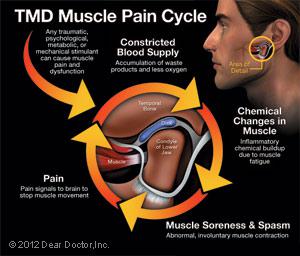
As with any other joint, the TMJ can be subject to orthopedic problems including inflammation, sore muscles, strained tendons and ligaments, and disk problems. We also know that TMD is influenced by genes, gender (women appear to be more prone to it), and age. Physical and psychological stress can also be a factor. In some cases, jaw pain may be related to a more widespread, pain-inducing medical condition such as fibromyalgia.
Signs and Symptoms of TMD
Clicking Sounds — Some people with TMD hear a clicking, popping or grating sound coming from the TMJ when opening or closing the mouth. This is usually caused by a displacement of the disk inside the joint. Someone standing next to you might even be able to hear it. Clicking by itself is actually not a significant symptom because one third of all people have jaw joints that click. However, if the clicking is accompanied by pain or limited jaw function — the jaw getting “stuck” in an open or closed position — this would indicate TMD.
Muscle Pain — This can be felt in the cheeks (masseter muscles) and temples (temporalis muscles), where the two big pairs of jaw-closing muscles are located, and possibly the neck. If you feel soreness and stiffness upon waking up in the morning, it's often related to habits such as clenching and/or grinding the teeth at night.
Joint Pain — Pain that originates from one or both jaw joints may be described as arthritis of the TMJ. Some people show signs of arthritis in imaging without symptoms, while others experience pain with normal imaging. Medication can sometimes help relieve symptoms.
Relieving the Pain
Once we complete an examination, we will come up with a strategy for treating your condition and managing your pain. Sometimes a temporary change to a softer diet can reduce stress on the muscles and joints. Ice and/or moist heat can help relieve soreness and inflammation. Gentle stretching exercises may help relieve muscle tension. Anti-inflammatory medications and muscle relaxants can also provide relief. Physical therapy can be beneficial once a diagnosis is developed.
Other Treatment Options
Severe TMD cases may require more advanced treatment once a diagnosis is confirmed. It is rare for major surgery to be necessary. It is important to try conservative, reversible treatments first and allow time for them to work, as they are often effective. The first step is a thorough examination at our dental office. We want to help relieve your pain and restore function.
To learn more about treatment options, contact Center For TMJ Facial Pain to schedule a consultation.